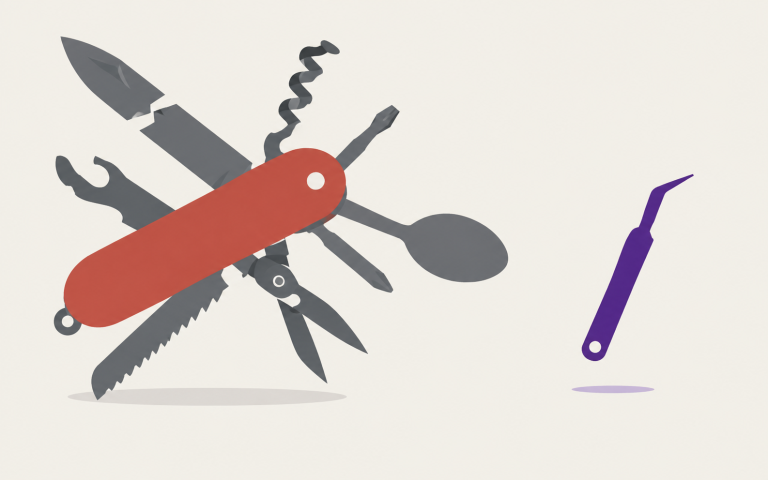
WordPress did not win the web because it was the best built thing out there. It won because for a long stretch it had no real competition, and because it never much cared who copied what. Both of those were strengths once. Both are now turning into the reason it is slipping.
- WordPress today
- 41.2% of the web
- Peak
- 43.6%, early 2025
- Growing fastest
- no CMS at all
The piracy problem and the decline are the same story told twice.
It won a race nobody else finished
When WordPress was finding its footing, the alternatives fell away on their own. Joomla and Drupal drifted into niches and, if we are honest, into long-term irrelevance: Joomla is down to 1.2% of the web and Drupal to 0.7%, from 3.3% and 2.0% back in 2015. Magento became its own heavy world. None of them built an ecosystem a normal person wanted to live in. So WordPress became the default less by being brilliant and more by being the one that was easier, more available, and safe enough to bet on.
That is a fine way to win. It is a bad way to stay comfortable, which is exactly what happened next.
Then everyone got comfortable
Time passed. New markets grew around the platform. Envato and ThemeForest turned themes into a gold rush. The first freemium plugins showed up, handing you the basics for free and charging for the parts you actually needed. And at some point the whole ecosystem exhaled and got comfortable. Too comfortable.
Every paid plugin has a pirated twin
Any premium plugin or theme with even one paying customer has a pirated copy somewhere online. Not a free build, not a community edition, not a stripped version for people who would rather not pay: a copy taken whole and rehosted, usually with something extra injected that the person downloading it will not notice until it is a problem.
I do not share the belief that code must belong to everyone by default. And I do not think the licensing stance WordPress takes, which effectively hands nulled sites a blank check, is the noble position it gets treated as. It is a liberal stance, in line with how the community and the company behind WordPress tend to lean, but leaning liberal does not make it fair. It frames every developer as someone who owes their work to whichever stranger decided they would rather not pay. That is not an ethic, it is a mood.

There is an honest counterpoint, and I will make it myself: a large share of the premium WordPress ecosystem is low quality. I understand why. The barrier to entry is almost nothing, the audience is enormous, and distribution was, for years, effortless. That last one is worth sitting with, because the thing that made WordPress easy to build for is now one of the reasons the newer platforms look more promising than it does.
But a weak product can be improved. Nulled sites were, are, and will remain. And the response from the people who could actually do something about them, the developers, WordPress itself, and the handful of marketplaces that monopolized this space and then stopped evolving, has mostly been to look away. There are almost no official claims filed against these sites. The work gets pushed onto the community, framed as openness, when a lot of it is the absence of anyone bothering.
The work gets pushed onto the community, framed as openness, when a lot of it is the absence of anyone bothering.
Meanwhile, the rest of the web kept moving
Then AI arrived, and with it a pace where skipping a single day means missing another release, another launch, another small thing that turns out to matter.
And WordPress? Its innovation never quite started. I still remember how the launch of Gutenberg in WordPress 5.0, December 2018 was sold as a success, a company with enormous revenue shipping a block editor so raw you mostly wanted to switch it off and forget it existed. And this was not early days. Shopify was already a serious platform. Webflow was taking shape. Small teams were walking forward one deliberate step at a time toward becoming leaders of the CMS world. The block editor only became something you could stand to use around 6.5, in March 2024, in my own opinion. Full site editing landed in 5.9, January 2022, which is eleven years after Visual Composer was selling drag and drop page building on ThemeForest, and it arrived dressed up as progress.
Look at where those others are now. Framer, Webflow and Shopify are sprinting past each other, and none of them is glancing back. In the last few months alone Framer has shipped more capability and expanded its ecosystem further than WordPress managed in years. Shopify keeps compounding improvements across its platform. Webflow pushed into new markets and made itself close to essential for a whole generation of designers and developers. WordPress added native AI connectors, notes on posts, and a handful of generic features that a decent model could reproduce in a dozen prompts. That is a little embarrassing, and it is what corporate complacency looks like when it sets in on both the company and the community at once.
The numbers have caught up to the feeling. W3Techs put WordPress at 43.0% of all websites in January 2026 and 41.2% by the end of July, its first run of six straight monthly declines in twenty years.
| Platform | Share of all sites, 30 July 2026 | First half of 2026 |
|---|---|---|
| WordPress | 41.2% | down 1.5 pt |
| Shopify | 5.3% | up 0.2 pt |
| Wix | 4.3% | up 0.1 pt |
| No CMS at all | 30.4% | up 1.3 pt |
Wix is the one worth watching in the longer view: 3.3% to 4.2% across 2025 alone, roughly a quarter added to its own size in a year, while WordPress went the other way. But the figure I keep coming back to is the last row. Most of what WordPress lost did not go to a competitor at all. The category growing fastest is sites running no detectable CMS, from 28.6% in December 2025 to 30.4% seven months later. A leak rather than a collapse, and a leak is the worse of the two, because it gives you years to fix it and nothing forces you to.
And under all of it, the piracy never stopped
Every CMS in that table fights piracy the same way, by improving its own ecosystem and owning its own environment, so there is less loose product to steal and less reason to want the stolen version. WordPress took the other road. Its answer, in effect, has been: we do not much care about your ownership, so build and copy, ship and ignore quality, because a bigger community is always better. It offloaded the problem onto people instead of solving it with planning or product.
And when ThemeForest and CodeCanyon finish dying, which they will, what is left? A free directory of unmoderated theme filler on wordpress.org, waved through by volunteers, where things get approved that a first year student would be embarrassed to hand in. Go and look at the quality in the free directory sometime. It is grim, and it is not moving.

None of this means WordPress disappears tomorrow. Forty percent of the web does not vanish on a schedule. But the thing that made it unstoppable, that it was everywhere and asked very little of anyone, is the same thing keeping it still while everyone else runs. Twenty years of being relaxed about ownership and relaxed about quality read as generosity at the time. It reads now like the reason the next twenty will be built somewhere else.