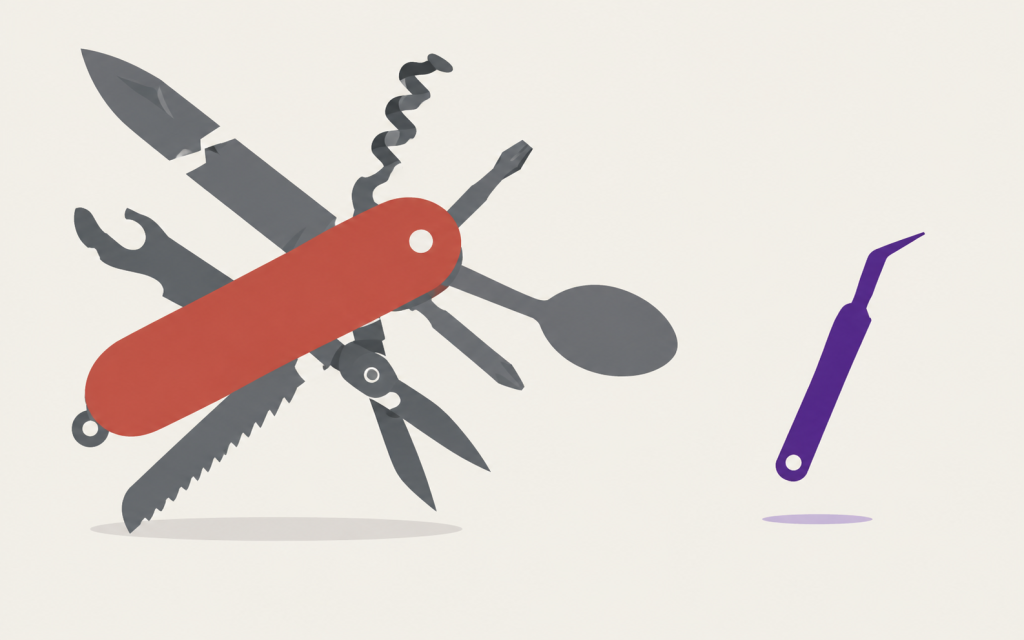

Agencies used to buy WordPress themes the way you buy a toolbox. One multipurpose theme, activated on every client project: the dentist, the gym, the freight company, the wedding photographer. Same theme, different demo import, invoice goes out. It looked like efficiency, and for a decade nobody had a reason to ask what was actually inside the box.
I know that world from the inside. I spent years building exactly these products, and the most popular theme I worked on sold five figures of copies. What follows is partly a confession.
- The pitch
- one theme, every client
- The reality
- eight plugins and a page builder
- Cause of death
- WordPress stopped being the default
How agencies bought themes, and why it worked
The workflow was almost a ritual. Open ThemeForest, sort by best sellers, buy the thing at the top, import the demo that vaguely matches the client, swap the logo, adjust the colors, ship. The theme promised to cover any niche, so the agency never had to think about the next client in advance. One license, one skill set, infinite verticals.
The promise held as long as two things stayed true: WordPress was the default way to build a site, and the number at the top of the marketplace listing passed for proof of quality. Neither survived. I wrote separately about what a sales count actually measures, so here I will only say that it measured the cover.
How they buy now
Watch a competent agency start a client build in 2026. A base theme or a block skeleton, an AI agent, and a short conversation: match this brand, restyle these sections, generate the missing templates. Days of clicking through theme options became a few prompts. When WP Engine surveyed 214 agency professionals in April 2026, 72% said they had already adjusted their development and design practices around AI, and 99% had taken at least one concrete step toward it.
The clients who do not want WordPress at all skip the question entirely. Framer raised $100 million at a $2 billion valuation in August 2025, with the analyst firm Sacra estimating its revenue roughly doubled year over year, and Webflow reports more than 200,000 businesses on its platform. Designers reach for those tools first now. A multipurpose WordPress theme is not even the fallback anymore; it is the thing an older colleague used to buy.
What an all-in-one theme actually is
Strip away the demo gallery and a multipurpose theme is a delivery vehicle for other software. Avada, the biggest name the category ever produced, documents this itself: two required plugins that must stay installed and activated at all times, plus six bundled premium plugins on top, from a lead-capture popup tool to two separate slider libraries. That is how the whole category is built; the best seller just writes it down.
Bundled premium plugins do not come with their own licenses. They update when the theme vendor repackages them, through the theme panel instead of the normal WordPress update flow, so every one of them waits on somebody else’s release schedule. And the wider ecosystem these stacks lean on is not aging well: 46.8% of the plugins in the official WordPress directory have not been updated in over two years, by a September 2026 full scan of all 67,855 of them.
Half of the theme options only ever worked in hand-customization mode. The other half quietly assumed that stack of plugins underneath. The result was everything for the screenshot, and very little for the site that had to live with it.
A multipurpose theme is a delivery vehicle for other software.
The exact moment it died
It was not AI that killed it, or at least AI did not get there first. The multipurpose theme existed because WordPress was the only serious option for an ordinary business site, so one theme stretched across every niche was a rational purchase. The moment WordPress stopped being the only option, stretching stopped being a feature and became bloat. W3Techs had WordPress flat around 43% of the web for years, peaking at 43.6% in early 2025; by September 2026 it sits at 40.7%. Part of that slide may be measurement method. The direction is not.

The authors, and the crying
The people who built fortunes on this model are now the loudest mourners at the funeral. For years the routine was comfortable: publish an update whose changelog amounts to one more super widget button, watch the Last update date refresh on the item page, collect the sales a fresh date brings. Marketplace guidance to authors has long framed regular updates as something that helps items sell. Nobody needed the button. Everybody needed the date.
Then the comfort ended. Exclusivity is gone, and from July 2026 every marketplace author is on a flat 50% revenue share, where the biggest exclusive sellers used to keep 87.5 cents of every dollar. The response across the top of the category was to freeze marketplace editions into fixes-only versions, raise prices, and herd buyers toward subscriptions on standalone stores, per a September roundup by ThemeREX, itself a marketplace author. I wrote about why the end of exclusivity is good news, and I stand by it harder now.

These were businesses that considered themselves specialists. The era of AI agents and decentralized tooling is showing what many of them were instead: people who jumped on a train at the right time, while the platform handed them free customers and asked for nothing in return. The train has stopped. The specialists are still working.
What replaces the dinosaur
The market now rewards the opposite shape: a niche theme that does one vertical properly, light enough to audit, focused enough to learn in an evening, with real infrastructure around it. Maintained documentation. Updates that arrive in the dashboard. A license that connects to something. Support with a history.
We bet the studio on that shape, and you can see it in what you get when you buy direct. The multipurpose theme was a creature of a marketplace that rewarded covers and a platform with no competition. Both conditions are gone, and the product that only made sense inside them is going with them.