In most Substack vs WordPress threads, people argue about convenience: how fast you can start, how pleasant the editor is, how easy the first issue goes out. Almost nobody adds the one thing that decides it. A blog on Substack is not yours. You write for Substack.
Substack is the faster start, and its network can bring your first readers. WordPress wins the moment the blog has to do more than share what you know: get cited, find sponsors, run ads, or carry an integration nobody else has. That is where the ready-made patterns end and where an open system you own keeps going.
- Substack to start
- Free, then 10% of paid subscriptions plus Stripe
- Substack custom domain
- $50 once; email still goes out from substack.com
- Leaves Substack with you
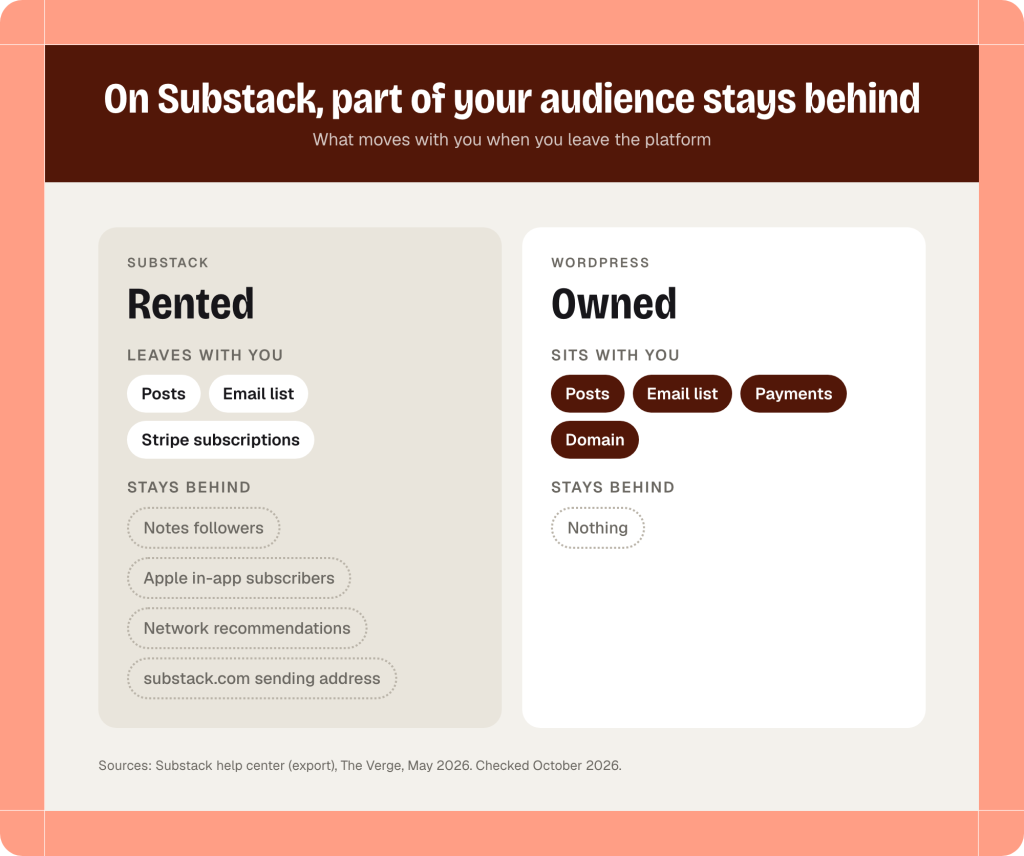
- Posts, the email list, Stripe subscriptions
- Stays on Substack
- Notes followers, Apple in-app subscribers
- WordPress software
- Free under the GPL; you pay for hosting
- Newsletter on WordPress
- Jetpack: 2% to 10% of paid subscriptions
What does the Substack vs WordPress debate leave out?
The Substack vs WordPress debate leaves out ownership: on Substack you keep your words, while the platform, the followers and the rules belong to Substack. The usual comparison is about ease, and on ease Substack wins. You sign up, pick a name, write, and the post lands on a web page and in inboxes at once. WordPress asks you to pick hosting, a theme, a newsletter tool and an update routine before the first post goes anywhere.
And yes, a Substack is partly yours to shape. You get your own subdomain, and for a one-time $50 you can connect a domain you already own, though newsletters still go out from a substack.com address. You can change colors, fonts, the logo and the header layout. Customization ends there: Substack supports no custom CSS or HTML, and only the embeds it lists.
The terms make the arrangement plain. Under the Substack terms of use (updated October 6, 2026) you keep ownership of your posts, Substack gets a perpetual license to host and distribute them, and it may remove content at any time, for any reason, and suspend or end an account. You own the words. The place they live, the address book of followers around them and the rules belong to someone else.
What leaves with you when you leave Substack?
Your posts, your email list and your paid Stripe subscriptions leave with you; your Notes followers, your Apple in-app subscribers and your spot in the Substack network stay behind. The Substack export gives you a zip with your posts and subscriber list, and that part works.
What stays behind is in the fine print. As The Verge reported in May 2026, writers can export subscribers but not people who only follow them through Notes, and readers who pay inside the iOS app pay Apple, so that billing cannot move with you. Ghost migration docs add one more catch: after a move, Substack keeps taking its 10% on existing paid subscriptions until you ask for the fee to be removed.
The Substack network argument cuts both ways. Substack says more than half of new subscribers come from its built-in network. That is real reach, and it is reach you rent. The growth engine, the feed and the recommendations are theirs, and they stay when you go.
What can you not do on Substack?
On Substack you cannot add custom code, plugins or ad slots, and sitemaps and brand media kits only open up once a publication has grown. Substack stops at the edge of its own patterns: it ships subscriptions, a social feed and a short list of embeds, and anything outside that list cannot be added. For a blog that only records what you know, that is plenty. Once the blog meets the hard part of publishing, every next step runs into that edge.
Getting cited
Getting a Substack cited by search engines and AI assistants is harder because you control so little of the page. Citation starts with pages machines can read and trust. On Substack, sitemaps and Google Search Console verification only become available as a publication grows, and since custom code is not allowed, you have no way to add markup of your own. On WordPress the titles, structured data, internal links and files like llms.txt are yours to set through the theme or a plugin from day one.
Sponsors
Sponsored posts are allowed on Substack, and since June 2026 it runs its own native sponsorship program. Its Creator Kits, the media kits for brands, are reserved for Bestsellers or publications with at least 100 paid subscribers. On your own site the sponsor page, the rate card and every placement are yours from the first post.
Ads
Substack builds no features for advertising or affiliate links, because its model is subscriptions. Since you cannot add custom HTML, an ad network has nowhere to put its code either. On WordPress, Google AdSense sets no traffic minimum, Journey by Mediavine starts at 1,000 sessions in 30 days, and Raptive at 25,000 pageviews a month.
Your own integration layer
Substack accepts IDs for Google Analytics, Tag Manager, Parse.ly and the Meta and X pixels, and that is the extent of it: no plugins, no code of your own. WordPress has 71,871 free plugins in its directory (counted in October 2026), and when none fits, someone can write the one you need.
An open integration layer is also how we build blog themes. Ours start from Verba, so co-author bylines, scored reviews, a TL;DR block and Mailchimp signup forms are parts of the theme itself, and we can change any of them.
| Substack | WordPress | |
|---|---|---|
| Setup | Minutes | Hours, then upkeep |
| Cost to start | Free | Hosting and domain |
| Cut of paid subscriptions | 10% plus Stripe | Jetpack: 2% to 10% |
| Own domain | $50 add-on | Yours by default |
| Built-in discovery | Network and app | None |
| Custom code | None | Anything |
| Plugins | None | 71,871 free |
| Display ads | No ad features | Any network |
| Stays behind on exit | Followers, app billing | Nothing |
What does WordPress cost you instead?
WordPress costs you hosting, updates, maintenance and the job of getting your email delivered. It is harder, and parts of it are plainly inconvenient. It is also fully open: the software is free under the GPL, and there is no edge to how far it can be extended. The price is work. You pay for hosting, you keep plugins and the theme updated, and the site is your problem when it breaks.
Running the newsletter yourself is the part people underestimate. Jetpack Newsletter is free and takes 10% of paid subscriptions with no plan, 2% on its Growth or Complete plans. MailPoet is free up to 500 subscribers and 5,000 emails a month, Kit up to 10,000 subscribers. Whichever you pick, getting mail into inboxes becomes your job; no platform does it for you.

If you are still deciding whether WordPress is the right self-hosted pick at all, we compared it with Ghost, Wix, Squarespace, Framer and Webflow, costs included.

How much does Substack cost compared with WordPress?
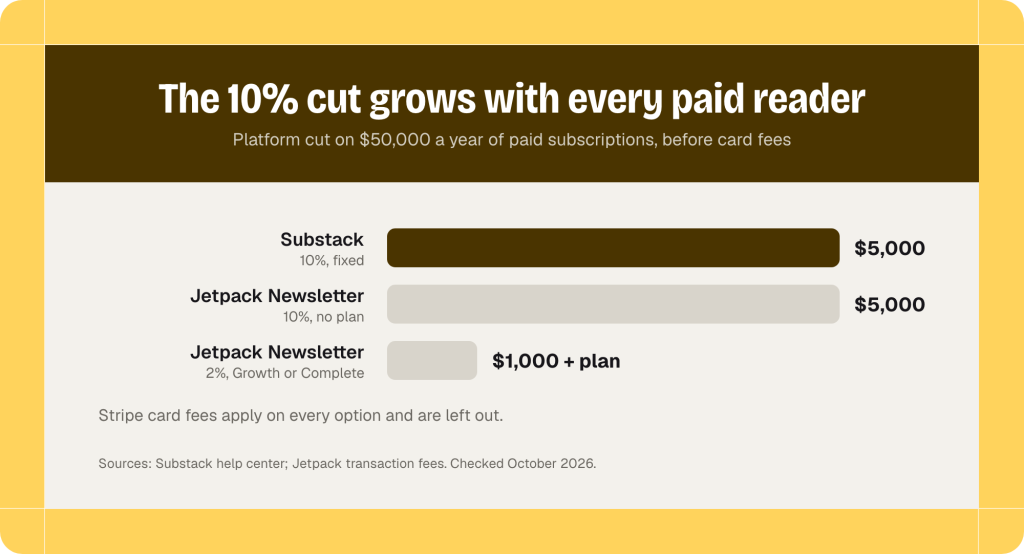
Substack costs nothing until you charge, then 10% of every paid subscription plus Stripe fees, for as long as you stay. On $50,000 a year of paid subscriptions that is $5,000 a year to Substack before card fees, and the cut grows with every new paying reader. One writer who moved to a flat-priced tool told The Verge he went from $4,968 a year on Substack to $2,052 on Ghost with an add-on.
On WordPress the cut is a setting. With Jetpack you pay 10% with no plan or 2% on Growth or Complete, plus the plan itself, and other membership tools set their own terms. Either way the choice is yours, and you can change it later without moving the blog.
When is Substack worth it?
Substack is worth it when writing and sending is the whole job and you have no time for a site. It suits you if:
- you want to publish this week and not think about hosting, updates or email delivery;
- you have no audience yet and the Substack network is your best shot at a first one;
- paid subscriptions are the only income you plan, with no sponsors page, ads or shop.
If any of those conditions stops being true, the blog has outgrown the platform, and the sooner you move the less you leave behind.
When does your own blog win?
Your own blog wins as soon as it has to earn, be cited, or do something nobody packaged for you. Until then Substack is a fine notebook. After that, the question is only how much you leave behind when you move.
A ready-made blog in three clicks will never compare with a self-hosted system you put time into, keep improving and, in the end, own.
What to do next depends on where you are:
- Starting from zero: put the blog on your own domain and WordPress from day one, and choose the newsletter tool before the first post.
- Already on Substack: export the zip every month, nudge Notes followers into real subscribers, and plan the move with the Substack Importer, which brings posts, images, podcasts and public comments into WordPress.
- Running both: publish on your site first and send to Substack with a link home, so the archive and the search traffic build up where you own them.
WordPress vs Substack: questions people ask
Is Substack a blog?
Yes. Every Substack post is a web page as well as an email, so a Substack works as a hosted blog with a newsletter attached. The difference from a WordPress blog is who controls the platform, the code and the rules.
Is Substack good for SEO?
Substack posts can rank, and you can set the URL slug of each post. Sitemaps and Search Console verification unlock only as a publication grows, and with no custom code allowed you cannot add structured data of your own, so WordPress gives you far more control over how search engines and AI assistants read your pages.
Can you put ads on Substack?
Not display ads: Substack builds no advertising features and allows no custom HTML. Sponsored posts are allowed, and Substack runs a native sponsorship program since June 2026.
Can I move from Substack to WordPress?
Yes. Export the zip from Substack, import the posts with the Substack Importer plugin, and import the subscriber CSV into your newsletter tool, since the plugin does not move mailing lists yet. Paid subscribers can come along only if your membership tool can take over the existing Stripe subscriptions; Apple in-app subscribers and Notes followers cannot.
Can I use Substack and WordPress together?
Yes. You can keep the archive on your own WordPress site and use Substack for distribution. Publish on your site first and link back from Substack, so the search traffic and the archive grow where you own them.