
An author website needs five things: a home page that says who you are and what you write, a page for your books or published work, a short about page, a newsletter signup and a way to contact you from every screen. That is the whole list, and the hard part is keeping it that short.
Wow effects and huge volumes of content work for agencies, blogs, shops and news networks. An author site works the other way. Picture a plain surface with one bright dot in the middle. The dot is you, and everything on the page should point at it.
- Pages
- Home, work, about, newsletter, contact
- Layout
- One column, one idea per screen
- Contact
- In the navigation, on every page
- Goal
- Still current in five years
What is an author website for?
An author website is a business card: a well-composed snapshot of you and your work for the reader, editor, agent, event organizer or client who just heard your name. Jane Friedman, who has advised writers on this for years, makes the same comparison and recommends a site even before your first book is out.
That purpose rules out a lot. Visitors don’t read a site front to back: in a classic Nielsen Norman Group analysis, people read about 20% of the words on an average web page. So the site is not another ten-color editorial layout where the visitor scrolls through dozens of screens while the information they came for flies around the page. It is the few facts that matter, placed where the eye lands.
The second job is to last. Build it so it still looks current in five years and you never have to redo it. Effects go out of fashion in months; a clean page with good type and the work itself doesn’t.
The site is a plain surface with one bright dot in the middle, and the dot is you.
The pages an author website needs
Five pages cover almost every author, and fewer is often better: Friedman notes that new visitors rarely view more than a couple of pages, so each one has to earn its place.
- Home: your name, what you write and for whom, your newest book or best piece, and one clear next step.
- Books or work: one page per book with the cover, the pitch and buy links, or a list of published pieces for a freelance writer.
- About: a short author bio (Friedman suggests 250 words or less), a real photo, and the facts an editor or host would quote.
- Newsletter: one signup form with a reason to join, repeated at the end of the book pages.
- Contact: an email address in plain text or a short form, linked from the navigation on every page.
The newsletter matters more than it looks. Social platforms change their rules; an email list stays yours. Which tool sends it is a separate decision, and our comparison of the two common setups for writers covers it:

What to leave out
The simpler the layout, and the fewer pointless pages and sections of filler text, the better the site works. Cut these before you build them:
- Sections that repeat the about page in different words on the home page.
- A long wall of every skill, tool or credit you have. Group it into one small block instead.
- An events page with no events, a press page with no press, a blog with three posts from last year.
- Effects that slow the first screen down: autoplay sliders, scroll hijacking, a loader before the content.

Author website examples by type of writer
Most author website examples online are galleries of famous names, which tells you what a big publishing budget looks like and little about your own site. The five pages stay the same for every writer; the page that leads changes.
| Novelist | Nonfiction | Freelance writer | |
|---|---|---|---|
| Home leads with | Newest book | The big idea | Best clips |
| Main page | Books in order | The book, talks | Writer portfolio |
| Newsletter offer | Sample chapter | Short essays | Optional |
| Proof | Reviews, awards | Press, talks | Bylines, clients |
Novelist
A novelist site leads with the newest book and a buy button, then the full list in reading order, which matters for a series. The newsletter is the main event: a Reedsy roundup of author sites points to sample chapters and similar reader magnets tied to the signup form. Add an events page only when there are events to list.
Nonfiction author
A nonfiction author sells the book and the expertise behind it. The home page states the idea in one sentence, the book page carries the endorsements, and a short media page offers a bio, photos and talk topics, which is what an author media kit is. This is also the one type where a blog pulls real weight, because the posts show the expertise the book sells.
Freelance writer
A freelance writer portfolio is a list of proof for the next client. Show what helps that client understand you, with more visuals and less text: a cover image or a screenshot of the piece, then the headline, the publication, the year and the category. Skip the long blurbs. If you cover five beats and use twenty tools, group them into one small table rather than a page of badges.
Writers who also sell visual work, such as illustrators or photographers, need the portfolio side too. Our guide to building a portfolio site covers that part:

What makes an author website stay current for years?
An author website stays current when the design gets out of the way: one column, contact in the navigation, pages that change without a reload and no effects that date it.
- One column, where you can: a single column reads the same on a phone and a laptop, and it never looks like last year’s grid.
- Contact on the first screen, or better still a simple call to action in the navigation, so it is one tap from every page.
- Pages that change without reloading: in SPA mode, short for single-page application, only the content swaps while the header and the reader’s place stay put, so nothing interrupts the browsing.
- Metadata kept to markers: title, year and category on a book or a clip; the rest belongs on its own page.
And yes, I know it is 2026 and you have a Claude subscription. You still don’t need the ultra-realistic WebGL cursor that makes the content fall through the floor into the next room. It is fun for a week and dated in a year, and it makes the reader look at the effect instead of at you.
A note on SPA mode, since I care about it: the themes of ours I name below ship it out of the box. It is not unique to us. Some AJAX portfolio themes do the same, such as Kinsey on ThemeForest, which runs on the Elementor page builder. What matters is that the theme does it natively, so you don’t have to bolt it on.
Does an author need a blog?
An author needs a blog only if it shows what you know. Think of it as a mirror of your competence: a client or editor won’t read it, but they will see what kind of information you publish.
If the posts are about how lovely an evening walk through the city is on a summer day, start an Instagram account. If they show your specialty through real experience, they do two jobs. They convince the visitor, and they can get your name quoted by search engines and AI assistants. Google says there are no special optimizations needed to appear in AI Overviews; the same useful, people-first pages that rank are the ones it pulls answers from.
For an author blog, that means one rule: write what a reader of your books or a buyer of your work would search for, and stop when you run out of things only you can say.
How to build an author website on WordPress
To build an author website on WordPress, register a domain with your name and choose a host that installs WordPress. Then pick a theme that already gives you one column, contact in the navigation and pages that change without a reload, and fill in the five pages. WordPress runs 39.4% of all websites according to W3Techs, so help and newsletter tools are easy to find, and you own the site, the domain and the list.
Our step-by-step guide to starting a WordPress site covers the setup, including the setting that keeps a new site out of Google:

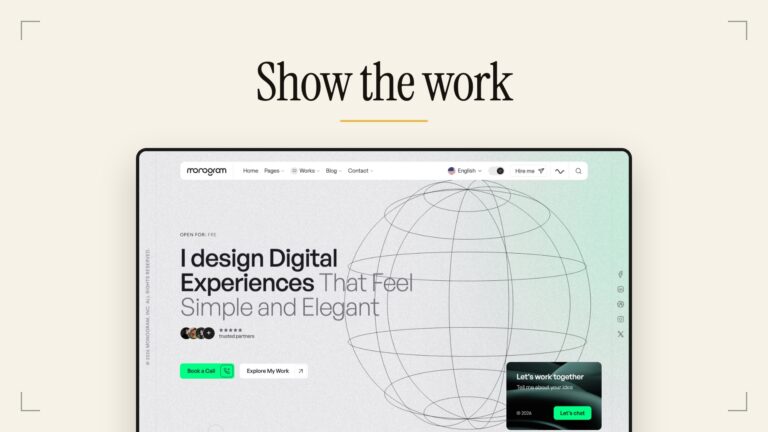
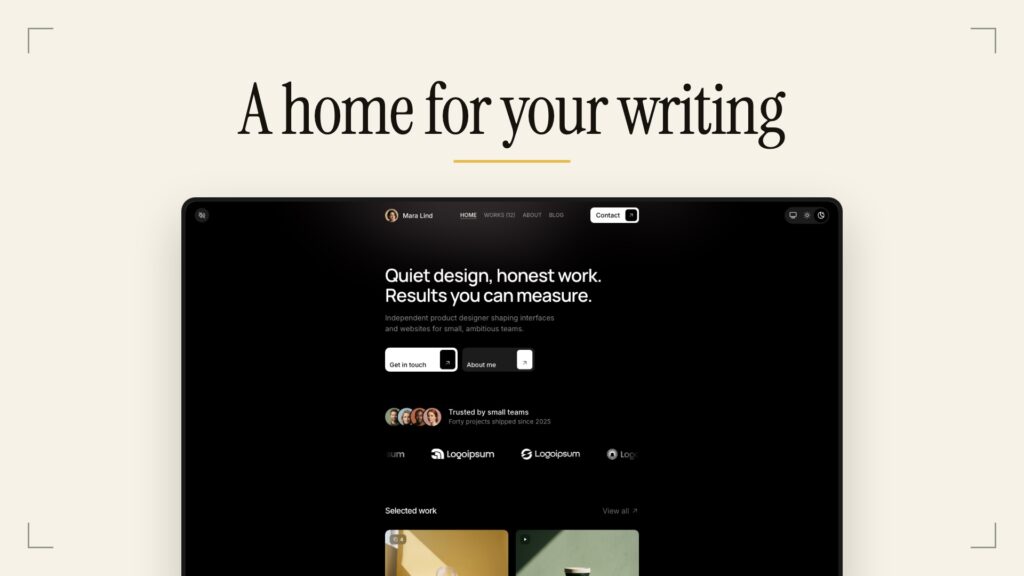
Then the theme. I built ours for exactly these people, writers and makers who need a modern design that doesn’t age, so read this as a recommendation, not an ad. Monogram is a personal portfolio for one person: it puts the work first and keeps the frame quiet. One Envato buyer wrote that they use it for their author site. Auno keeps one calm column, changes pages without reloading, and posts signup forms straight to a Mailchimp list. If your site is mostly the writing itself, the Personal demo of Verba builds a person-first front page around one author and their posts. The rest is on our themes page.
When a one-page site or a link in bio is enough
A one-page site is enough when you have one book, or no published work yet. In the same piece on unpublished writers, Friedman says that for very new writers one or two pages can be enough: a bio and whatever work you can show.
A link in bio page is a different thing: a list of links on someone else’s platform. It works as a stop between social apps, but it is rented. Put the same list on a /links page of your own domain and you keep the address when the platform changes.
Questions authors ask
What is the best website for authors?
The best website for an author is one on a domain with your own name, on a platform you control. WordPress, Squarespace and Wix can all host it; what decides the result is a short structure, a clear first screen and a newsletter you own.
Do authors need a website before they publish?
Yes, if you plan to keep writing. A simple site with a bio, contact details and a few pieces of work lets editors and agents check you, and it reserves your name as a domain before someone else does.
What should an author bio on a website say?
An author bio should say what you write, for whom, and one or two facts that prove it, such as publications, awards or expertise. Keep it short, write it in the third person if hosts will quote it, and add a real photo.
Where to start today
Buy the domain with your name first; it is the one step that gets harder with time. Then write the five pages in a plain document before you open any builder, and cut whatever you can’t fill. Only then pick the theme, and choose the one that makes the dot in the middle easiest to see.