Elementor runs on 12.8% of all websites and 31.5% of WordPress sites, in the sample W3Techs tracks, on a September 2026 reading. That is one website in eight of the ones W3Techs looks at. Whatever is happening to page builders, it is happening slowly.
The part I find more telling happened at the end of June 2026, when the company behind it laid off about 100 employees, roughly 30% of the workforce, and named AI as the pressure rather than any competing editor. The statement reported by Globes in June 2026: “we underestimated the speed of technological disruption and its impact on the old model.”
- Of all websites
- 12.8%, flat
- Of WordPress sites
- 31.5%, rising
- Of sites attributed to a builder
- 43% mobile, back to 2022
Five Elementor shares, and only one of them falls
Every argument about page builders runs on a share, and there are at least five in circulation. They count five different populations and move in three directions. Quoting one without saying what it is a share of is how one product ends up described as dominant in one write-up and collapsing in the next.
| What is being counted | Reading | Direction |
|---|---|---|
| All websites in the W3Techs sample | 12.8% | flat |
| Websites with a CMS W3Techs can identify | 18.5% | flat |
| WordPress sites in the W3Techs sample | 31.5% | rising |
| WordPress mobile origins the HTTP Archive crawls | 33.25% | rising |
| WordPress sites attributed to a page builder | 43% mobile | falling |
The falling one is the last row, and it is the row that gets quoted on its own. In the 2025 Web Almanac CMS chapter and the two before it, the Elementor slice of WordPress sites attributed to a page builder ran 43% on mobile in 2022, rose to 56% in 2024, and came back to 43% in 2025. Desktop went 40, then 54, then 42. A peak in the middle of a series is a different animal from a slide, and the 2025 reading sits exactly where the 2022 reading did.
What changed between those two charts is the list itself. The 2025 chapter puts the WordPress Block Editor among the top five page builders at 18%, and the 2024 chart has no such row. Every incumbent drops by roughly the same proportion that year: WPBakery from about 21% to 13%, Divi from about 14% to 10%. If that 18% row were the only change, each of the others would scale by about 0.82, which puts Elementor at 46% against the 43% reported. So most of that thirteen-point drop is the category widening to take in the thing builders were invented to replace, and a little of it is ground lost. The chapter gives no cause at all; the arithmetic is mine.
Meanwhile the share the write-ups treat as sinking has been climbing. Elementor is detected on about a third of the WordPress mobile origins the HTTP Archive Tech Report covers, 33.25% in the August 2026 crawl. Detection there is home page only, and the crawl reaches roughly 2.8 million public origins in the Chrome UX Report rather than an install base in the tens of millions. Two unrelated methods land within two points of each other, which is more agreement than either one earns on its own.
The shape of the story is deceleration. The Elementor share of WordPress mobile origins went 3.8% in early 2020, 15.1% in 2022, 26.2% in 2024, and 32.67% in the April 2026 crawl, as read by GravityKit from HTTP Archive data. The annual gain has come down from five or six points to 2.51, and year over year growth from about 28% in early 2023 to 8.3% in the twelve months to April 2026.
Elementor grows more slowly every year, inside a category that widened underneath it.
The gap builders were built to fill
WordPress 5.0 shipped the block editor on 6 December 2018. For years after that, building a landing page natively meant writing CSS for anything past a stack of full-width sections. The Site Editor and the first default block theme arrived with 5.9 on 25 January 2022, and even then the editor had no way to make a heading behave one way on a laptop and another on a phone.
Builders existed because that gap existed. Everything people complain about in them, the wrapper markup and the proprietary storage format you cannot leave behind, was the price of the one thing they could do that core could not do at all. I have shipped sites in Elementor and inherited more of them than I care to count, and none of that was a mistake at the time.
The gap closed on 19 August 2026
WordPress 7.1, Mary Lou, added per-breakpoint styling controls. The release announcement puts it plainly: “Style how a block looks at different screen sizes from Global Styles or in individual block settings, without custom CSS.” That was the last version of the layout argument that still held water.
That capability landed on 19 August 2026, three weeks before this post went up. Anyone who picked a builder before that date had a real reason, and both large builders spent the past year engineering out the weakness my argument leans on. A reason that expired in August 2026 is a thin thing to plan five years around.
What the performance evidence supports
Two kinds of evidence get quoted in this argument, and they answer different questions. One is a lab test of a single page. The other is what happened to people who visited real sites.
The lab test that gets quoted
In a comparison published by WP Rocket, article last updated June 2026, the same sample page built with the block editor scored 89 out of 100 with a 3.5 second page speed figure and a 2.2 second LCP, while the Elementor build scored 81, 5.0 seconds and 3.1 seconds, and the WPBakery build scored 80 at the same 5.0 seconds. One sample page, identical content and design, the same hosting, theme, images and plugins, a server in France, an iPhone 14 mobile profile, measured with GTmetrix. The article carries no test date and never states whether caching was on. Only the builder varied, so the result belongs to the builder rather than the theme underneath it.
The people who ran it reached the opposite conclusion from mine. The article closes by telling you to build the site you want and let the caching plugin handle performance, and the follow-up puts the WPBakery build at 100 and 0.5 seconds once caching is on. The company that ran the test sells that plugin. The finding holds anyway.
What real visits show
Field data is the better evidence, because it comes from visits that happened.
In the HTTP Archive Core Web Vitals Technology Report, August 2026 crawl, 48.7% of WordPress origins pass all three Core Web Vitals on mobile and 53.3% on desktop. Passing means the 75th percentile value for that origin is good on LCP, INP and CLS at once, measured per origin rather than per page.
| Editor or builder | Mobile origins passing all three |
|---|---|
| WordPress Site Editor | 63.73% |
| Bricks | 55.73% |
| Beaver Builder | 53.98% |
| Block Editor | 53.08% |
| WordPress overall | 48.74% |
| Divi | 41.68% |
| WPBakery | 38.61% |
| Elementor | 36.83% |
Site Editor and Bricks origins are newer, smaller and more often developer built, so part of that spread is who builds on what rather than what the code does. Bricks and Beaver Builder both sit above the Block Editor.
The builders sit inside a platform that trails every hosted competitor on the same crawl: WordPress 48.74% of mobile origins, Duda 85.96%, Wix 81.21%, Shopify 76.51%, Squarespace 72.14%, though Duda counts 45,113 mobile origins against 2,752,367 WordPress ones, a 61x difference and a different kind of site behind it.

Where a builder still earns its place
There is work the block editor still does badly.
- Pixel-level control on one-off landing pages, where the design is the product being sold.
- Motion and scroll effects that would otherwise be a custom script somebody has to maintain.
- Popups and conditional content tied to a page, a user role or the state of a cart.
- A theme builder that drives headers, footers, archives and single templates from one set of rules.
- Design-heavy commerce, where category pages are art directed one by one instead of templated.
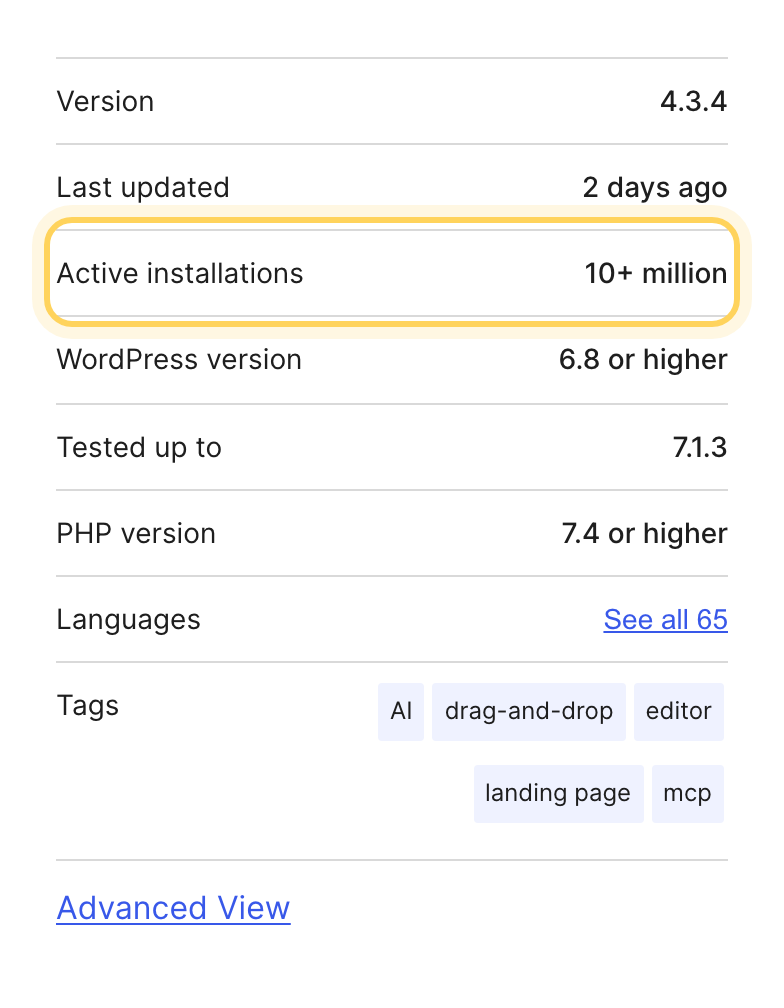
Both vendors shipped a rewrite this year. Elementor 4.0 arrived on 30 March 2026 by the published changelog, making the Atomic Editor stable and default for new sites while existing sites opt in; the current release is 4.2.4 from 31 August 2026, and the plugin page reports 10+ million active installations. The claim behind the rewrite is that Atomic Elements render from plain HTML tags with no extra wrapper layers, aimed straight at the wrapper markup that made the DOM heavy in the first place. No benchmark has been published and no independent test exists, so it is a stated intention and I treat it as one. Divi 5 left beta on 26 February 2026 after more than a year of public testing, and Elegant Themes has committed to supporting Divi 4 for at least another twelve months.
Bricks is what I reach for when a project needs a builder, and I want to be careful about how much that means. It sits at 0.4% of the WordPress sites W3Techs tracks and 0.1% of all websites, and it does not appear in the Web Almanac top-five chart. By crawl volume it is a rounding error beside Elementor, and it still sits at the top of the table above, next to Beaver Builder, which holds more than twice its share of WordPress sites and gets written off as legacy.

The reason most people keep the one they have
None of that explains the installed base. A page builder stores your content in its own format, and switching it off leaves the shortcodes sitting in the post content with nothing left to render them.
What a WPBakery page looks like after the plugin is gone
The post content is still in the database, and this is the whole of it. Every layout decision lived in the plugin that no longer parses these tags.
[vc_row][vc_column width="1/2"][vc_column_text]
Ten years of experience, and a team that answers the phone.
[/vc_column_text][/vc_column][/vc_row]
Multiply that by four hundred pages of a site somebody inherited.
Nobody rebuilds a working site to remove a builder they stopped liking. So the decay is slow, and it is measurable. WPBakery peaked at 12.57% of WordPress mobile origins in August 2022 and was at 8.52% by the April 2026 crawl, in the same GravityKit reading of HTTP Archive data; the W3Techs sample puts it at 7.4% of WordPress sites and 3.0% of all websites today. Two counts on two different populations, agreeing on the direction: roughly four points shed over nearly four years.
A large part of that base never chose WPBakery. It arrived bundled inside a theme bought on ThemeForest, sometimes with the license key held by the theme author rather than the site owner. Almost nobody in that base has made a fresh decision about WPBakery in four years, and the ones who try find the shortcodes waiting for them.
Switch the builder off and the shortcodes stay in the post content with nothing left to render them.

The native side has its own failure mode
Leaving a builder behind is not automatically clean, and I have made this mess myself. The block editor makes it trivial to duplicate a pattern, adjust it inline and move on. Do that for a year with three editors and nobody owning the design, and you have a dozen versions of the hero section in production with no single source for any of them. The markup advantage does not survive that, because each variant carries its own inline styles onto every page it lands on.
Core is closing that hole. Since WordPress 7.0, unsynced patterns and template parts inserted into the editor default to contentOnly mode, which exposes text and media for editing but not the block structure or the style controls; synced patterns open through an Edit original button in an isolated editor, per the core team note from March 2026. That turns pattern drift from the default behavior into something an editor has to work at. It still leaves somebody owning theme.json and the pattern library, and on most sites nobody does.
How I choose now
| No builder | Chosen for output | Inherited | |
|---|---|---|---|
| Fits | Content sites | Design-heavy client work | Whatever it was bought for |
| Layout ceiling | Raised in WordPress 7.1 | Highest of the three | Whatever 2019 allowed |
| Mobile pass rate | 53.08% | Up to 55.73% | 36.83% to 38.61% |
| Cost of leaving | The blocks stay put | A planned rebuild | A rebuild you keep postponing |
Two rules cover almost every project that has come through here in the past year.
- A content site, a blog, a news section, documentation, an affiliate build, gets a block theme and no builder. That has been the right answer for longer than the release dates suggest.
- Design-heavy client work gets a builder, chosen on the weight of what it puts on the page rather than on what the team learned to use in 2019.
The bad reason to keep one is that it is what we have always used. It is behind a large part of the installed base, and it is the only reason that gets more expensive every year you act on it.
One last number, from the W3Techs ranking breakdown for September 2026. Among the sites whose CMS W3Techs can identify, Elementor sits at 18.5% overall, 11.4% of the top million and 7.4% of the top 100,000, then 4.2% of the top 10,000 and 4.6% of the top 1,000. Each tier is a share of the identified sites inside that tier, and the fall is not perfectly clean: the top 1,000 ticks back up. WPBakery does the same thing harder, 4.4% overall against 1.8% in the top 1,000. Inside the top 100,000, fewer than one identified site in ten runs Elementor.
Common questions
Are WordPress page builders dead?
No. Elementor runs on 12.8% of all websites and 31.5% of WordPress sites in the W3Techs sample, but its growth slows every year, and the layout gap builders were made to fill closed with WordPress 7.1 on 19 August 2026.
Do page builders slow down a WordPress site?
They can. In the HTTP Archive Core Web Vitals Technology Report for August 2026, 36.83% of Elementor mobile origins passed all three Core Web Vitals, against 53.08% for the Block Editor and 63.73% for the Site Editor. Part of that spread reflects who builds on what, so it does not measure the code alone.
Should I use a page builder or the block editor?
A content site, blog, news section, documentation or affiliate build gets a block theme and no builder. Design-heavy client work gets a builder, chosen on the weight of what it puts on the page rather than on what the team learned to use in 2019.